Raksha Bandhan
A Myth Retold
- I -
Indra was losing the war.
Ever since that first morning when the demons attacked, Indra had lost every single battle. Not for lack of strength, of course. Indra was the strongest being alive. But he couldn’t overcome the cunning of the demons. They harried and distracted him, spinning him in circles till he tired himself out. No matter how determined he was each morning, it took mere hours for the demons to leave him stunned. By nightfall, he was utterly confused and climbed back up Mount Meru in a stupor.
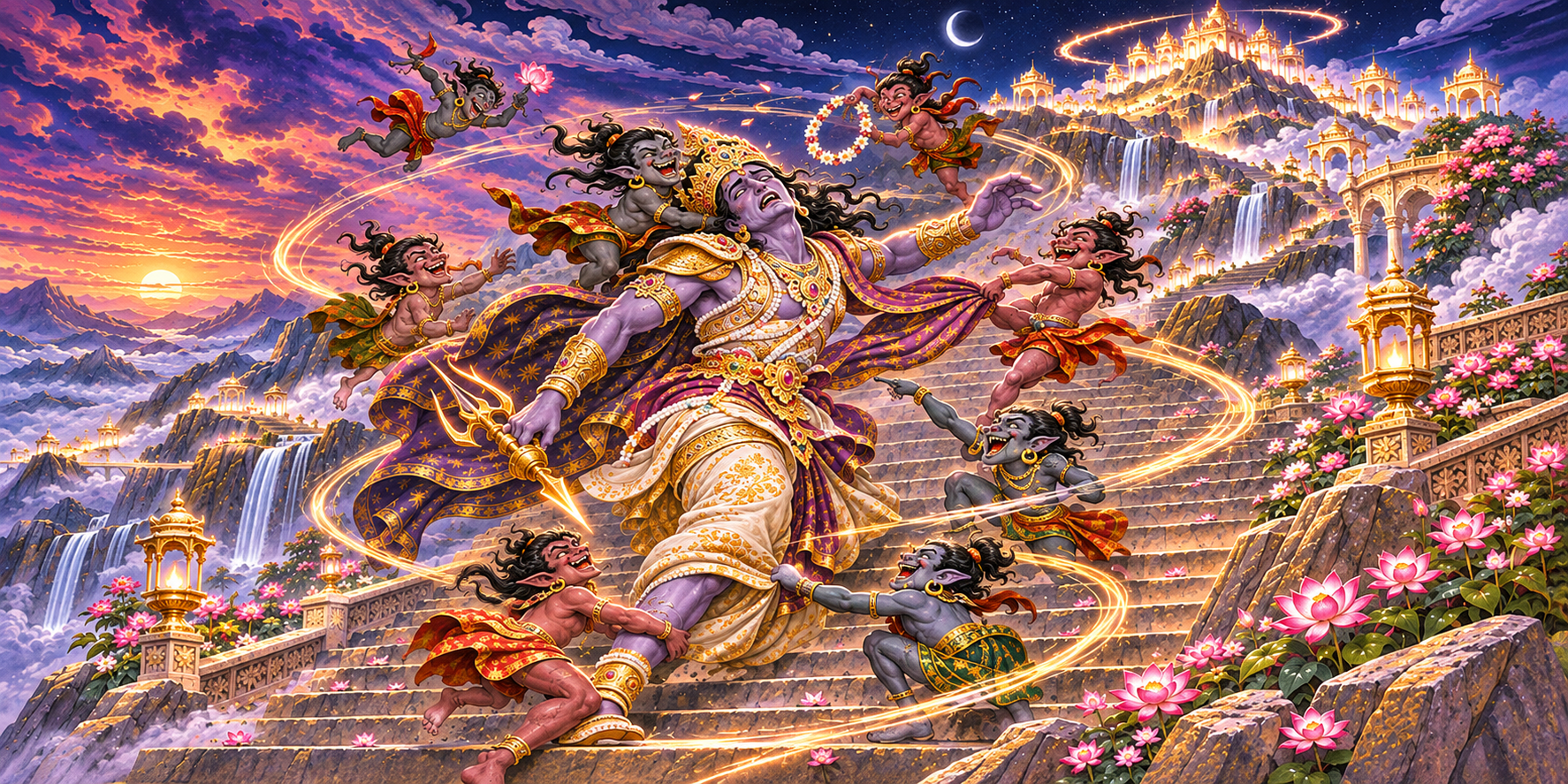
Naturally, as the king of the gods, this infuriated Indra to no end. “Kings are not supposed to lose!” he muttered to himself and anyone else within earshot.
But beyond the blow to his ego was a consequence most dire. For you see, the war between Demons and Gods did not turn on life and death. After all, both sides were immortal.
Rather, it was Good versus Evil that hung in the balance.
Sachi, the king’s sister, was desperate to help her brother prevail. So after seven years of this stalemate, she went to Vishnu, the wisest in the pantheon. And Vishnu gave her a piece of thread.
“This is supposed to defeat the forces of Evil?” Sachi asked, unsure.
Vishnu just smiled with a sage’s knowing grin and closed Sachi’s hand around the gifted string.
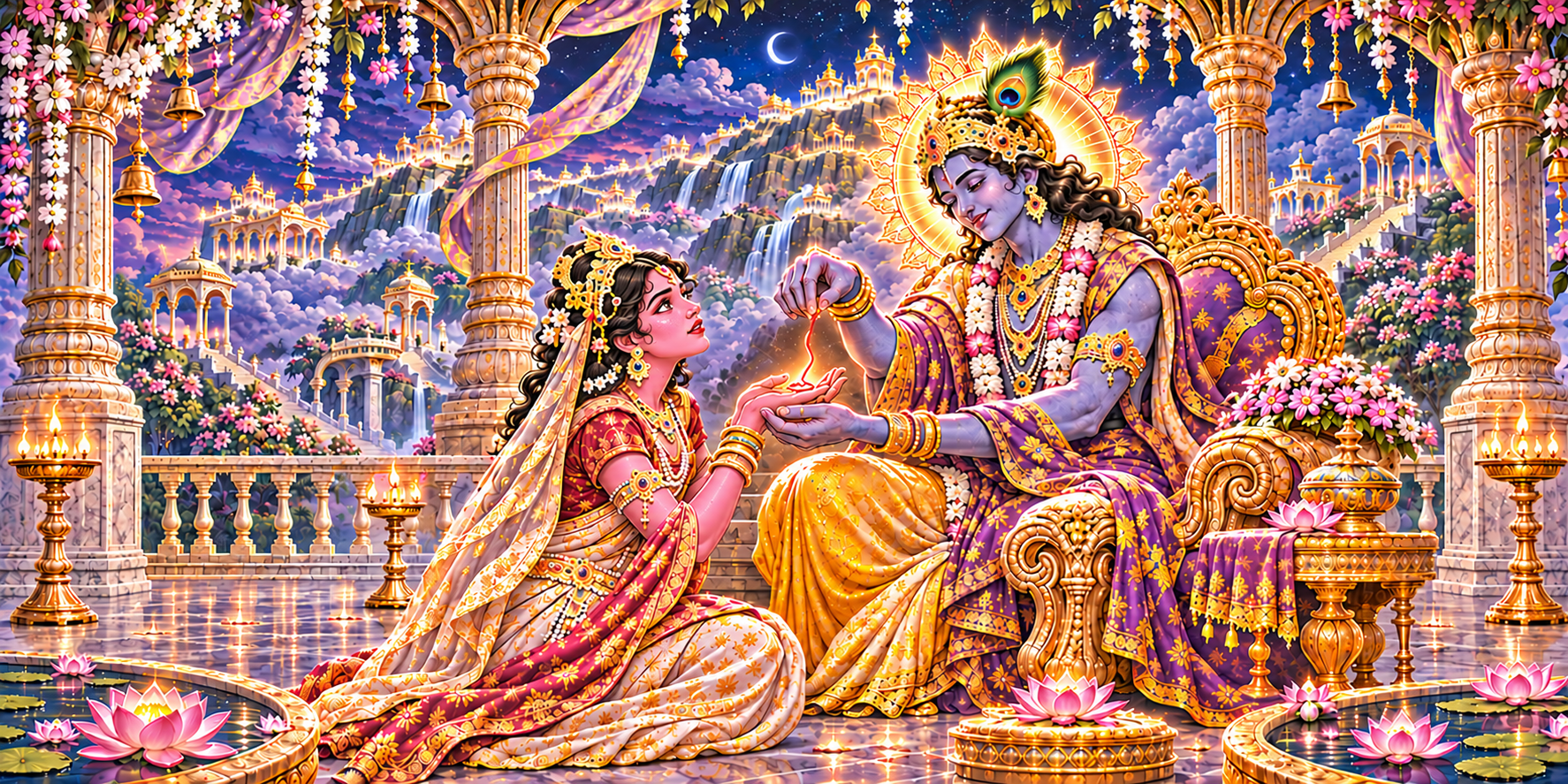
So Sachi returned to court. All night, she prayed over the simple thread, and in the morning, she tied it around her brother’s wrist. “Never forget,” she commanded. “You are bound to me. I will love and support you no matter what.”
When Indra returned to the battlefront, the demons danced around him like they always did. Taunting and jeering. Tugging at his ear lobes and whiskers. Yanking on his fingers and toes.
Just as before, Indra reacted wildly. Responding to every nit with reckless abandon.
But then one of the demons grabbed at the string on his wrist. And Indra remembered his sister. Suddenly, the demons seemed so very small. Silly, even.
With a calm that surprised even the king of the gods, Indra simply swatted the demons away.
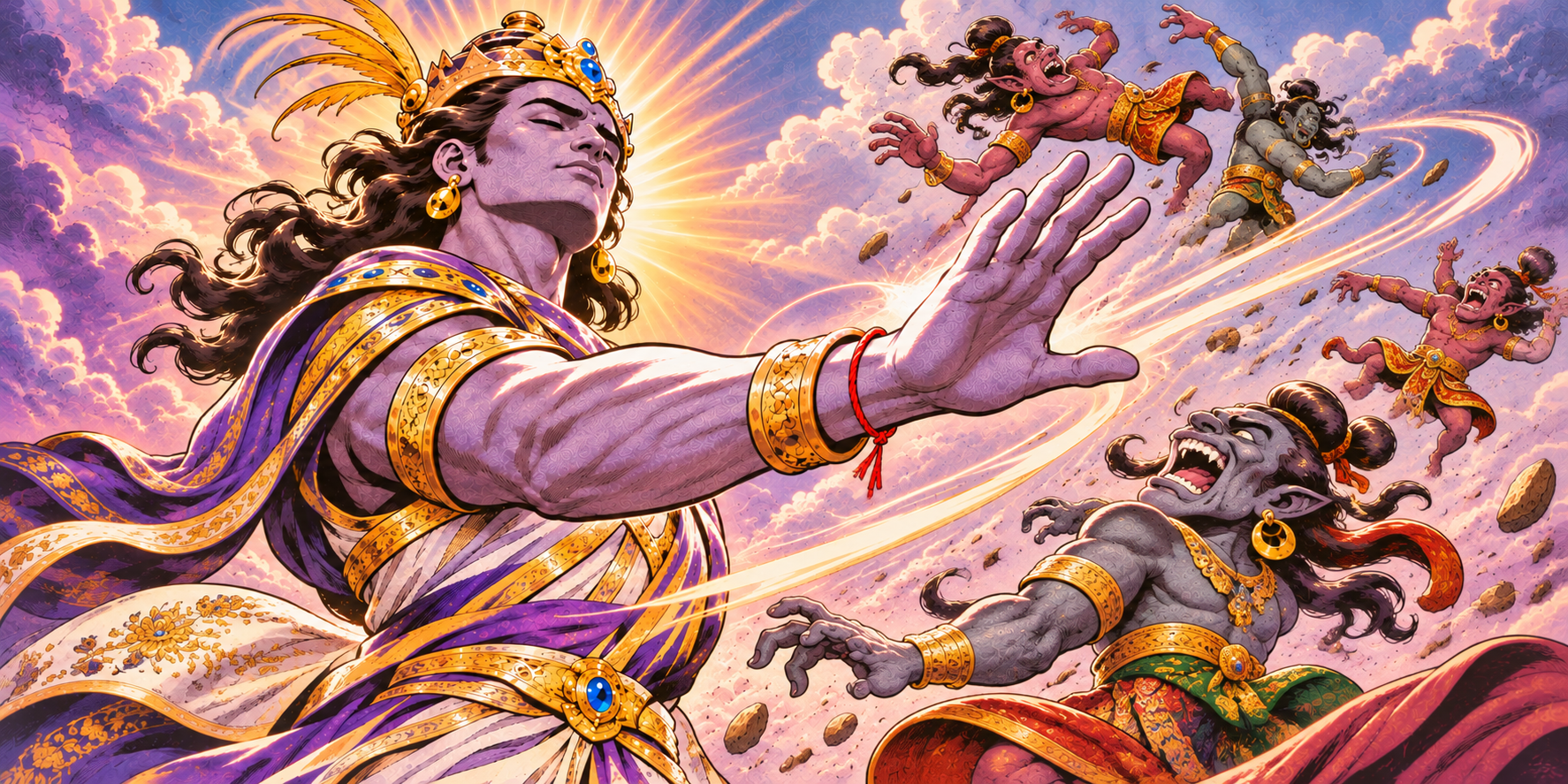
He won that day’s battle. One victory led to another and then another, until finally the demons were beaten back to whence they came.
All thanks to a slender piece of string and its powerful reminder.
- II -
For one thousand years, peace reigned in the heavens without interruption.
Which, it turned out, was rather dull for Vishnu.
What good was wisdom in a realm without conflict?
So Vishnu did what sages do best: he meditated. It wasn’t long before his grin returned.
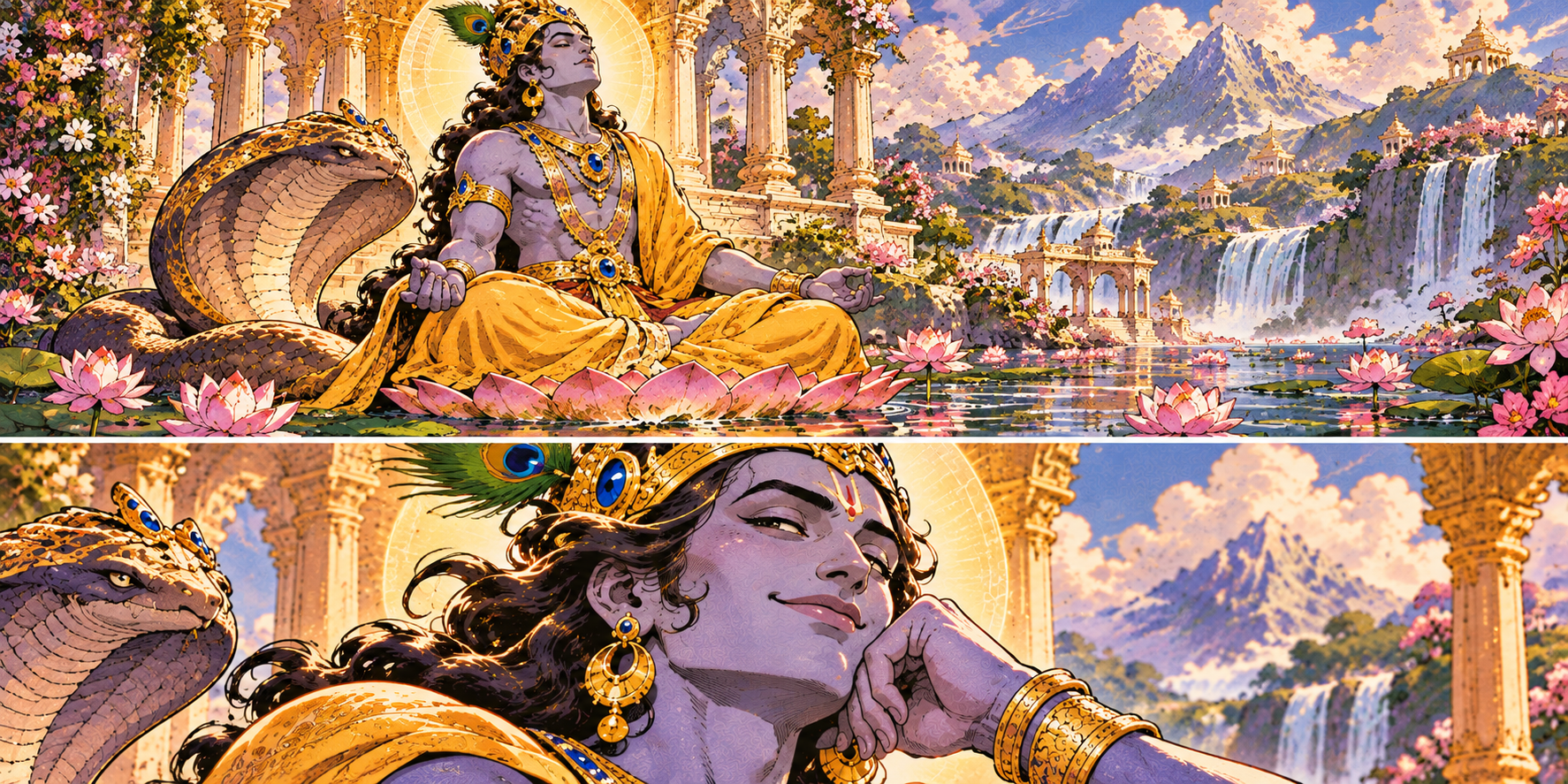
He decided to depart for more chaotic pastures. Lord Brahma was going on and on about his latest creation, Man. Might as well see what all the fuss was about.
The little fellows did not disappoint. So much emotion! Fear, wonder, anger and compassion.
Most puzzling of all was that everywhere he went, the villagers saw him and cried, “Dark! Dark!”
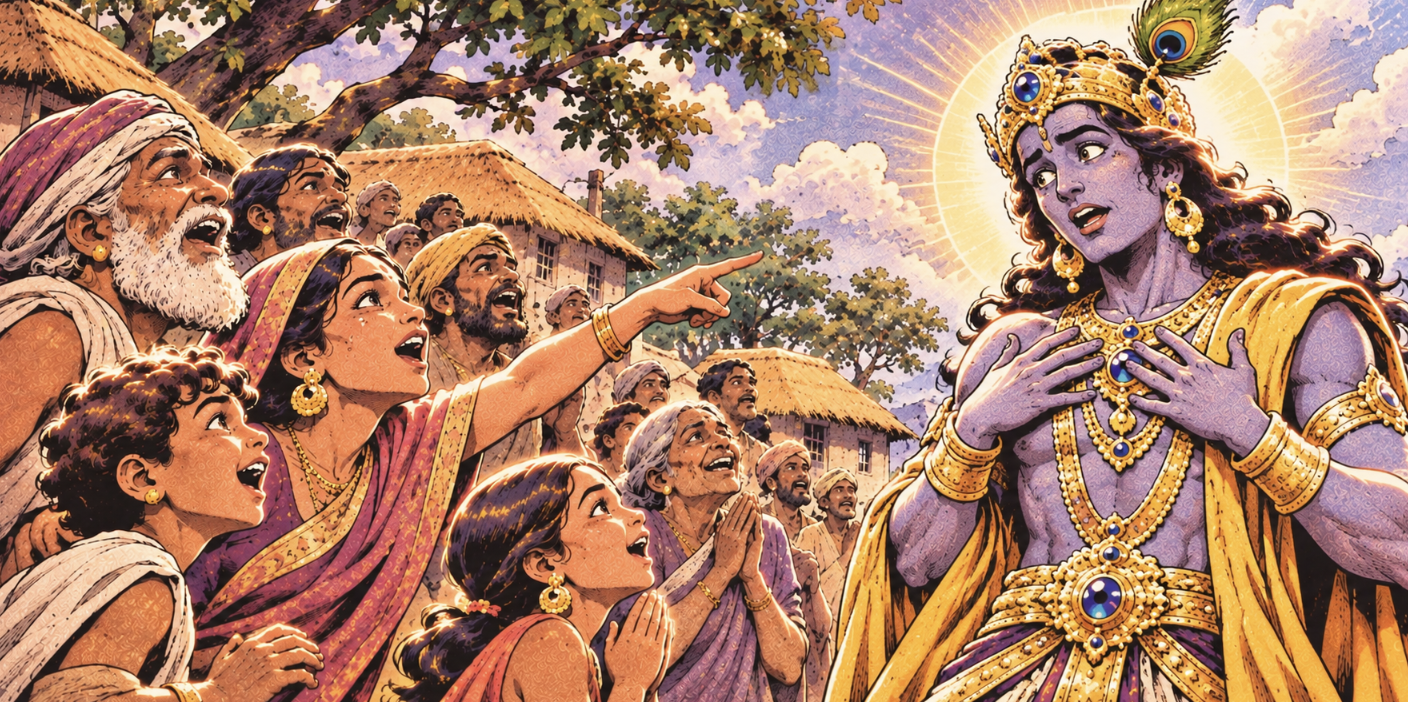
How odd, thought Vishnu, it’s the middle of the day.
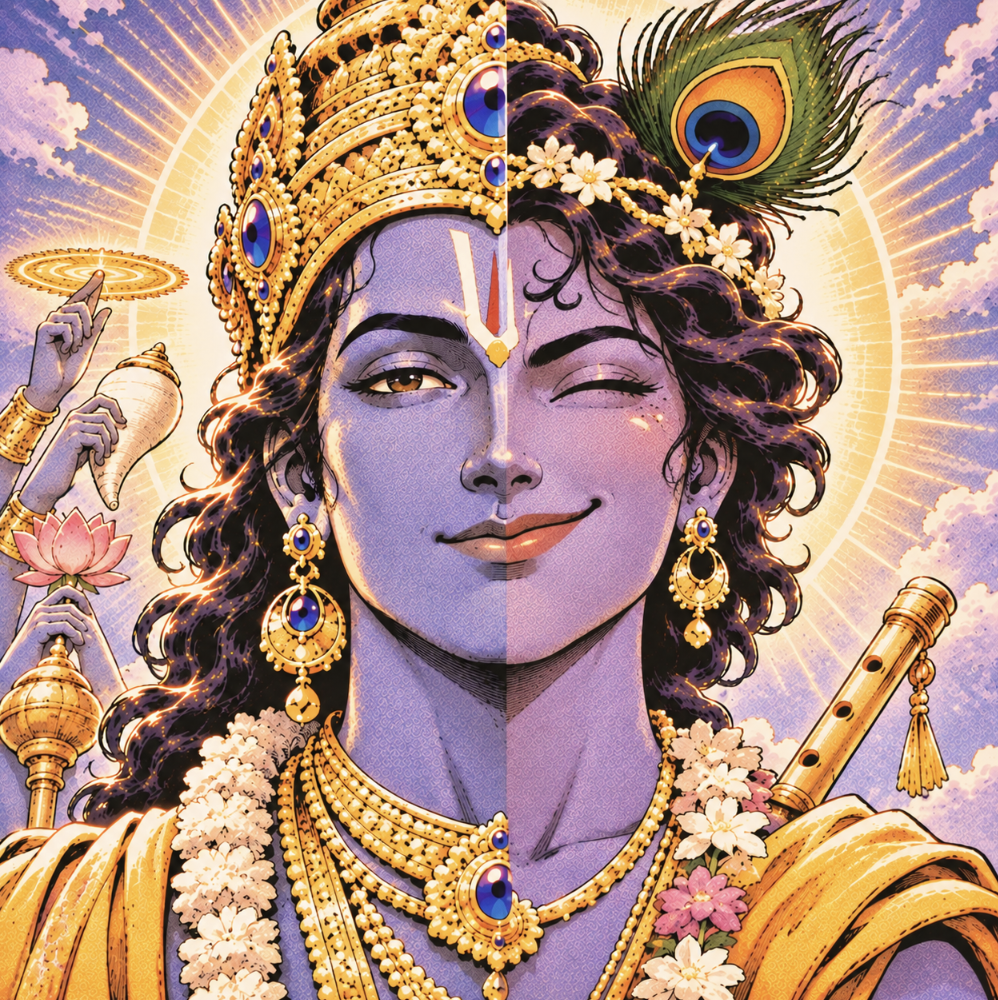
The Sanskrit word for dark is, of course, krishna.
- III -
A few centuries later and Krishna was walking through the streets of Panchla, enraptured by Man’s swift evolution from villages to great cities such as this. He walked right up to the palace gates and was met with a loud clanging. Curious, he turned the corner to see the royal smiths, hard at work. An object most shiny glinted in the sun and caught his eye. Before anyone could stop him, he reached out and grabbed the freshly forged dagger by the blade.
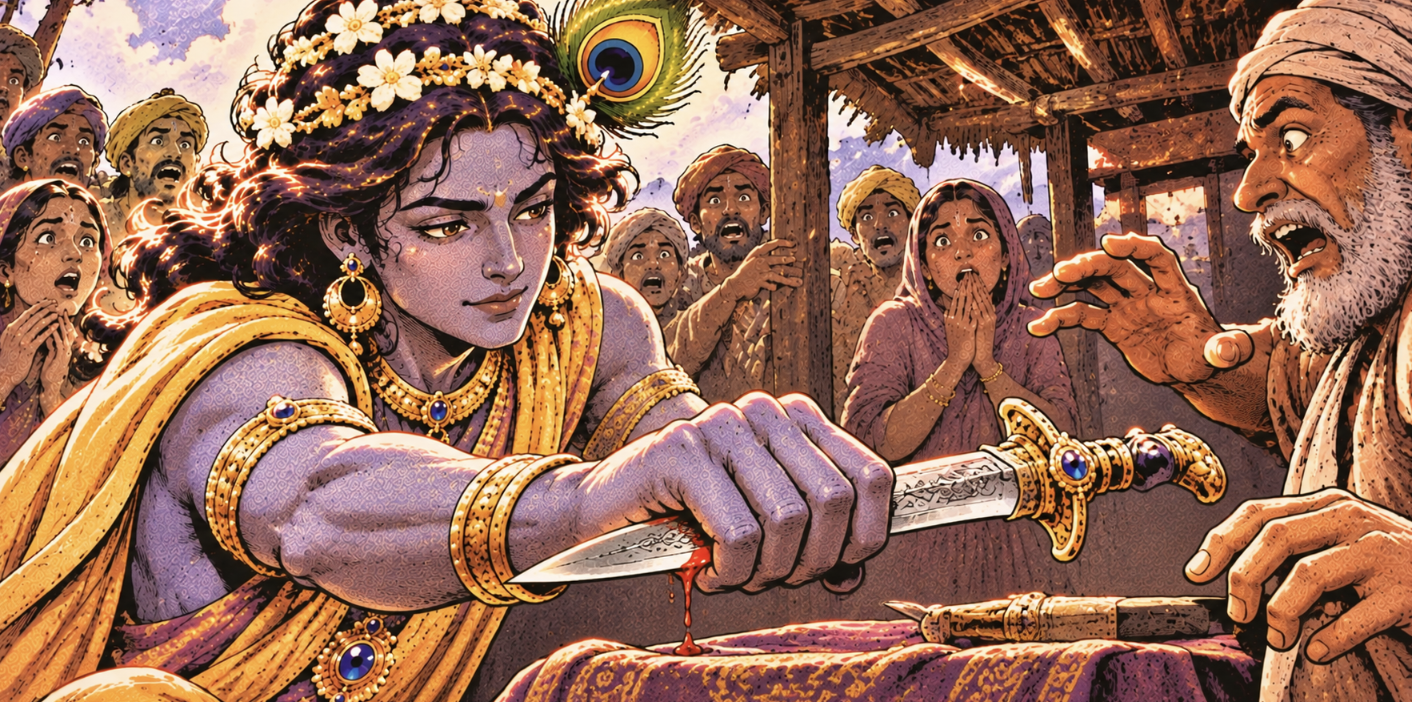
Naturally, everyone panicked. After all, they had no idea that while Krishna bled, he was yet immortal.
The master smith started barking orders: “Get water!” “Get the doctor!” One apprentice grabbed a hot poker to cauterize the wound.
Amidst the chaos, a young woman of twelve or thirteen walked calmly through the frantic workers and right up to Krishna.
In one fluid motion, she tore off the bit of her sari’s excess fabric called a rakhi and wrapped it around Krishna’s hand.
“Silly men,” she said to Krishna with a knowing smile that looked eerily familiar, “So afraid of a little blood.”
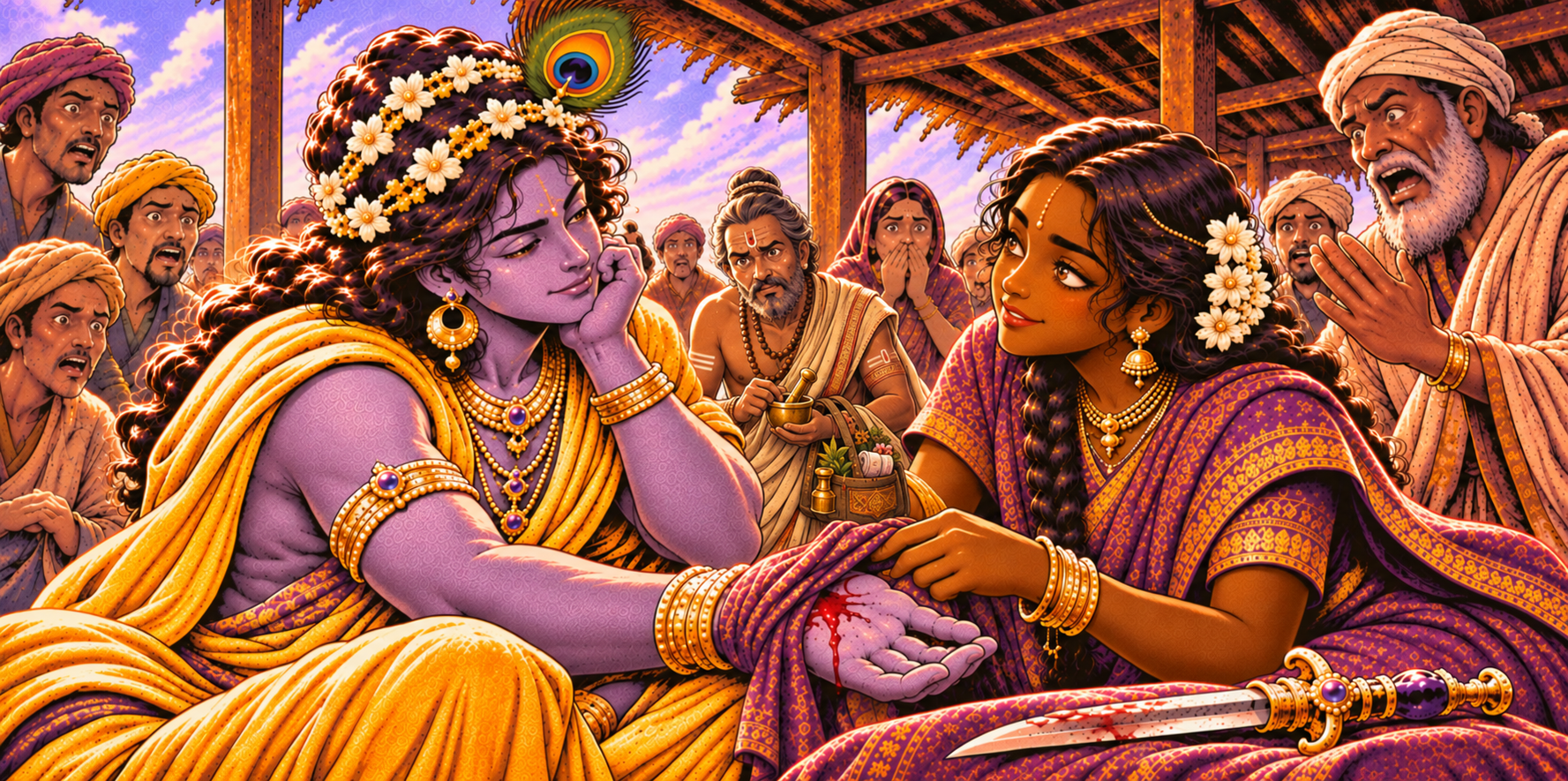
By this point, the commotion had stilled entirely. Everyone in the forge was . . . kneeling.
“I don’t believe we’ve been introduced,” said Krishna, offering his good hand.
The men scoffed at Krishna’s foolishness. Could he not tell he was in the presence of royalty?
“Oh shut up, bloody!” Queen Draupadi scolded. “This man is obviously a stranger here and still learning our ways. I am Queen Draupadi,” she offered.
“Majesty,” Krishna replied, bowing deep. “You are most kind. My friends call me Krishna, and so that is what you shall call me. For this rakhi,” he gestured to the dressing around his hand,
“I am in your debt. If you are ever in danger, cry out my name and wherever I am, I swear I will protect you.”
“Oh please,” she rebuffed. “It was just a bit of cloth. No need for such melodrama.”
At that exact moment, Krishna vanished in a puff of blue smoke.
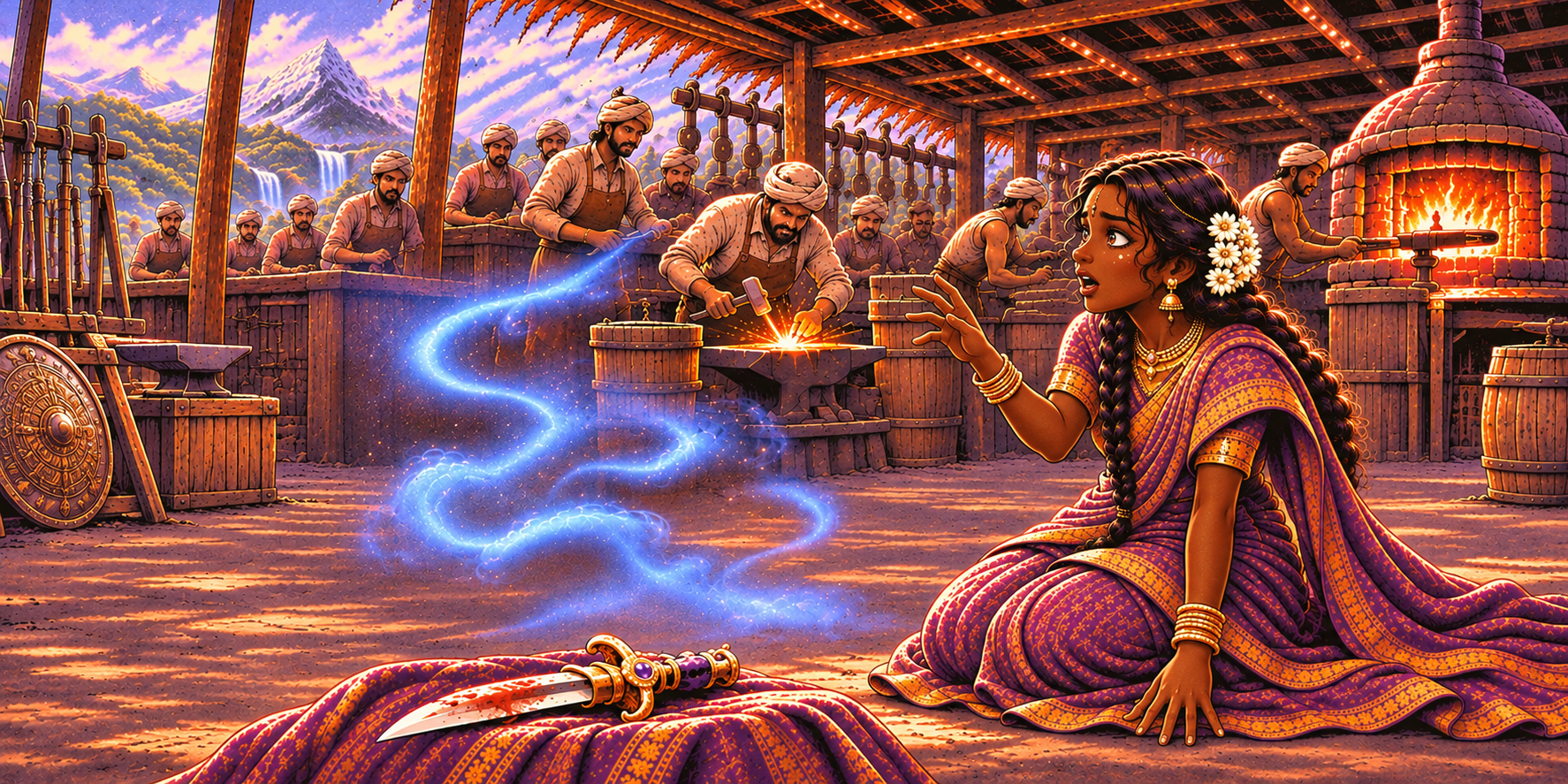
The Queen cried out in shock. But everyone around her resumed their duties as if nothing had happened at all.
Then Krishna’s voice rang out, though he was nowhere to be seen:
“The rakhi is an eternal reminder—I am bound to you. I will protect you no matter what.”
The Queen’s shock lasted for days, but not weeks. Over time, as she grew out of adolescence, she convinced herself it was just a vision. Perhaps even a dream.
Still, whether it really happened or not, she never forgot Krishna’s promise.
- IV -
In a blink of immortal time, it’s nine years and five weddings later. Ever the clever ruler, Queen Draupadi expanded her peoples’ wealth and prosperity not through conquest, but with multiple marriage treaties. In just one generation the Panchla grew to rival the greatest power in all of India at that time, the Kauravasthi.
What the Queen didn’t count on was that for each of her five husbands, there was an angry, jealous cousin stewing in the Kauravasthi court.
“It’s not fair!” cried Shekun. “We spent generations pitting these local lords against one another and with five quill strokes, the whore of Panchla has united them against us!”
“Arrhey!” the other cousins roared. Each began clamoring for favor from Dilithraja, the aging king.
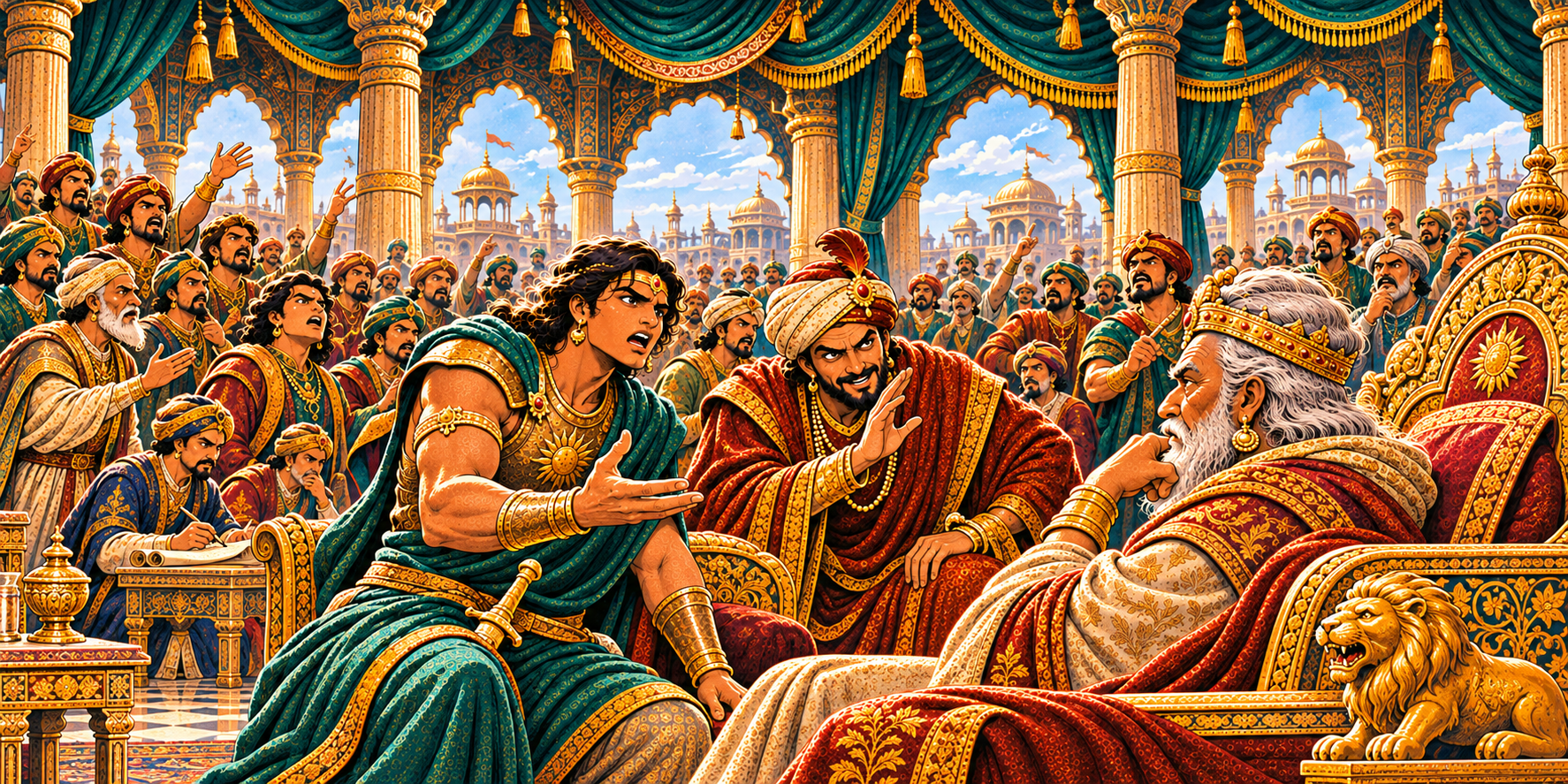
“Sire, I’ll draw up battle plans,” offered Karna, head of the army.
“My spies tell me their trade routes are ripe for the picking,” piped up vizier Dusha.
But Raj Dilith spat at each suggestion. “And give the Panchla an excuse to rally their troops? This is no ordinary network of alliances, you fools. This is the marriage bond five times over. You would give these young, ambitious husbands a chance to prove their love eternal?”
The Raj was growing red in the face when his eldest son, Duryodh, placed a hand on his father’s shoulder and whispered something soft. Slowly, Dilithraja eased back into his throne and smiled a sinister smile.
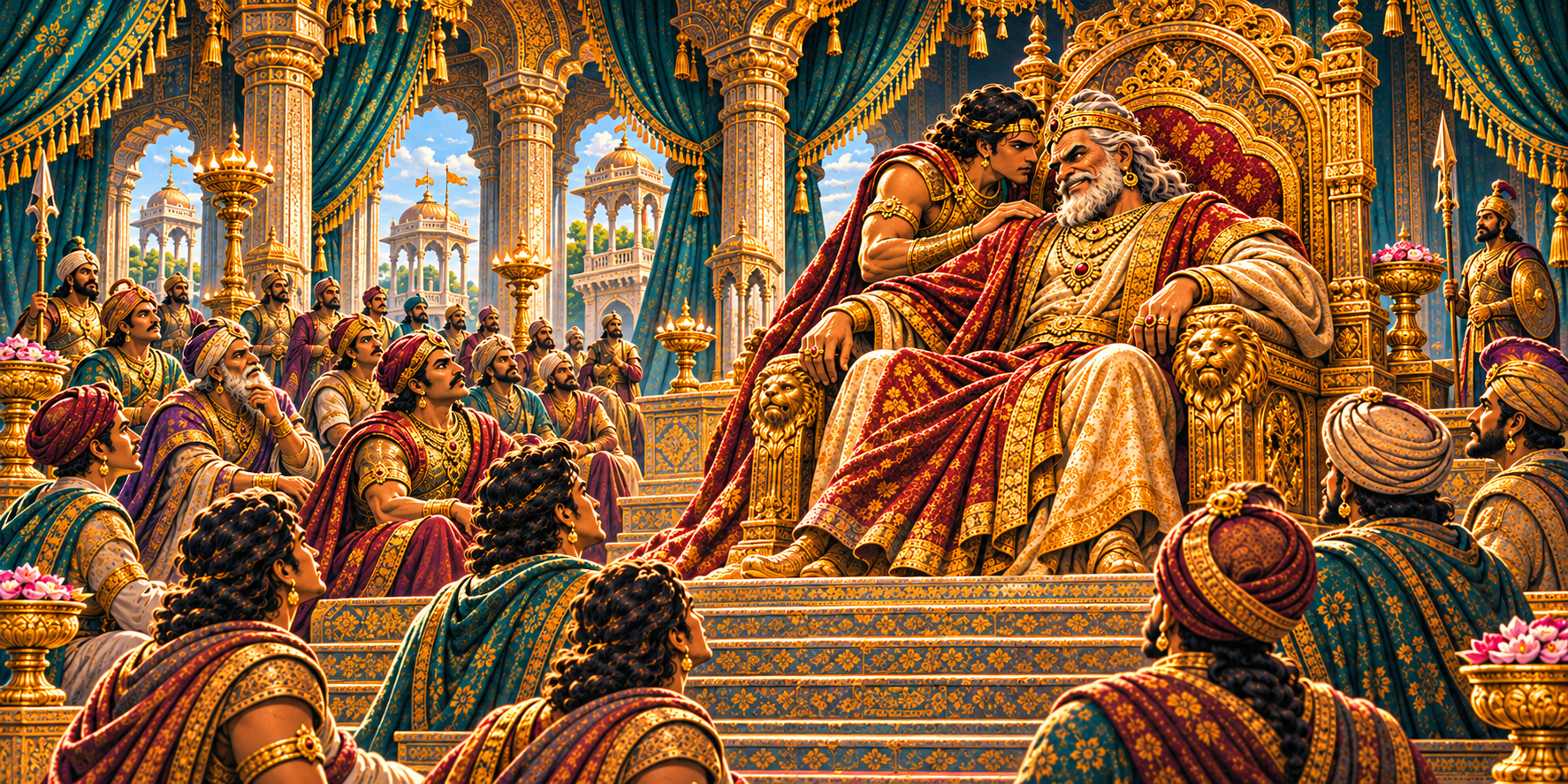
“Brilliant, my son. Send the riders out at once.”
As Duryodh strode down the steps to see to the Raj’s will, his cousins nipped at his heels to ask what was going on.
“If this so-called great Panchla Empire can be knit together with some sheets of paper,” he explained,
“Then surely, dear cousins, we can take it down with a flick of the wrist.”
- V -
Queen Draupadi stood in the courtyard of Hastinapura, stark and alone. All around her, the Kauravasthi royals and advisers were on their feet, taunting and jeering in wicked victory.
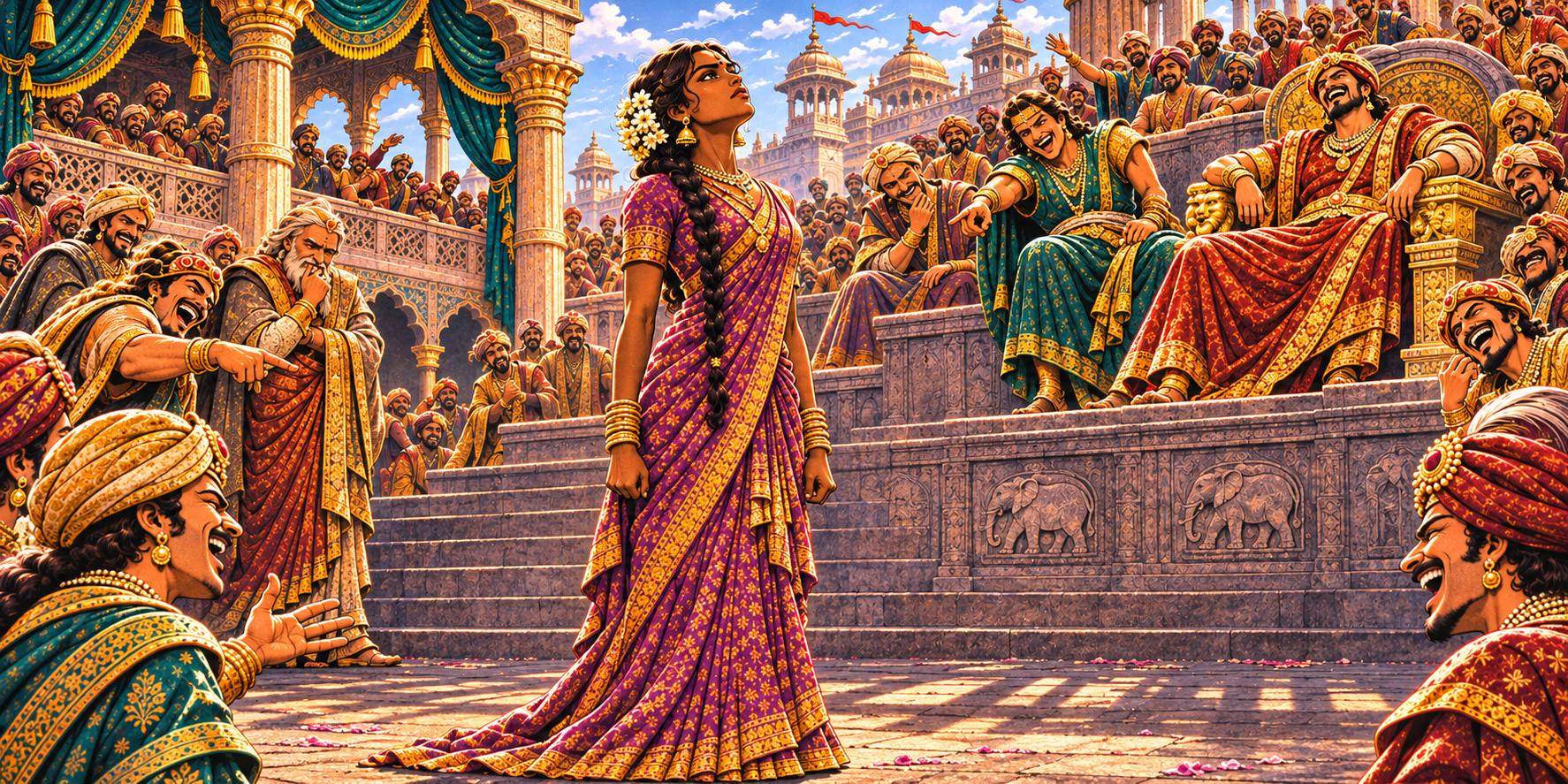
Her husbands were long gone, locked in the cellar, having wagered and lost in what she now realized was a rigged game of dice.
“Quite the fool is your first husband,” Duryodh said dryly. “When my father challenged his honor he practically jumped at the chance to defend himself!”
“You’re a liar and a cheat!” replied the Queen, chin high but knees trembling.
“Obviously,” gave Duryodh, “But the great, honorable Yudhistharaja couldn’t make such a dishonorable accusation, now could he? Not in public, and not against a fellow Raj. No, no, whatever the smart move may have been, he was honor-bound to come all the way here, in person, with court and matron in tow, and accept our challenge at face value. He barely blinked when the high judge asked for his attestation!”
At that, the cousins all snickered and began a reenactment, egging on the rowdy crowd.
“Is your honor as great as your kingdom?”
I swear it!
goaded the court.
“Is your honor as great as your freedom?”
I swear it!
hands to chests in mock salute.
“Is your honor as brave as your brother Bhima?”
I swear it!
dipping a fake quill in ink and signing the attestation.
“As honed as your brother Arjun’s bow and as tough as the twins Nakul and Sadev?”
I swear it!
they roared.
“Then prove it,” Duryodh said as he cast the dice high over the marble playing board.
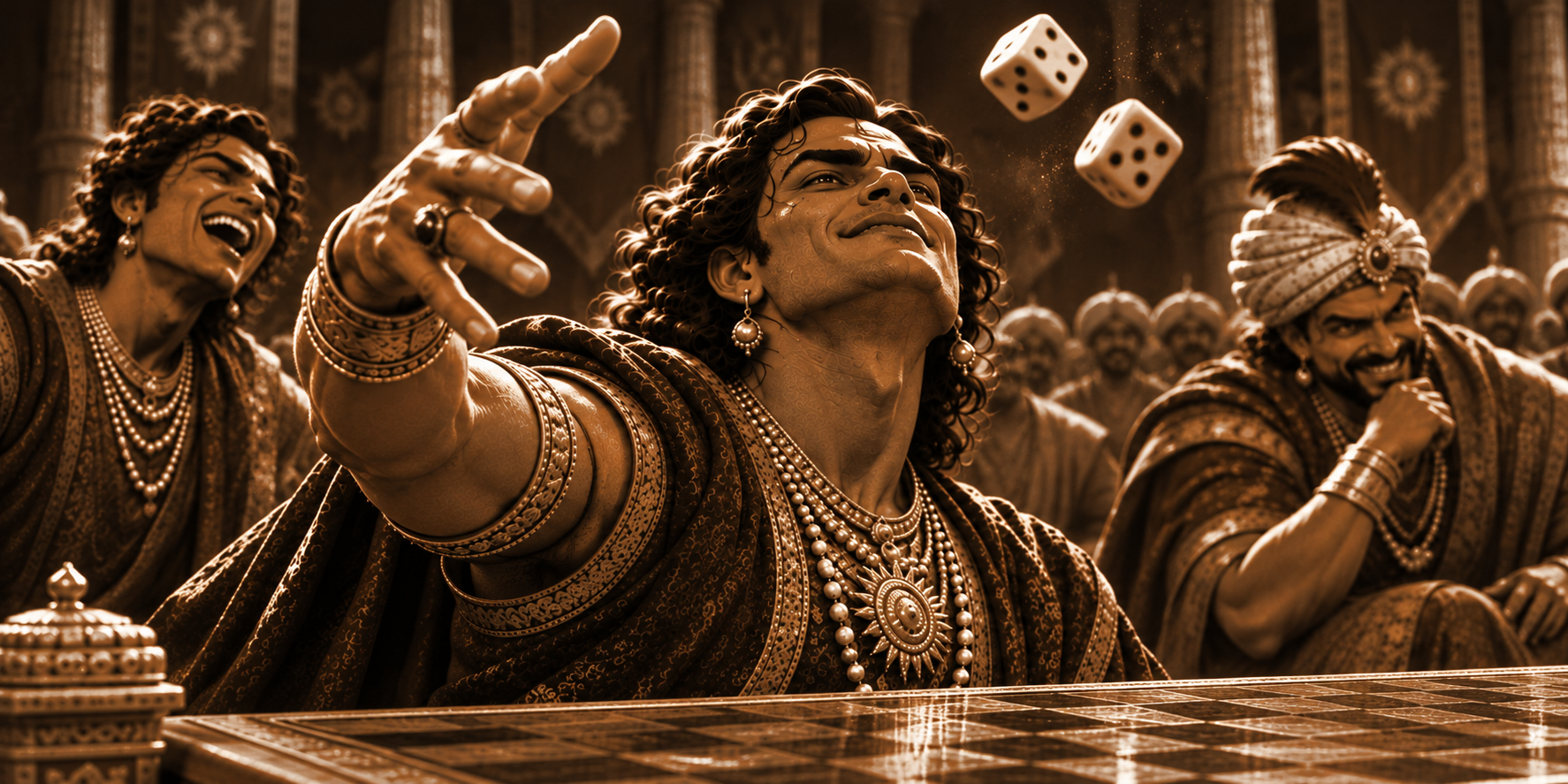
All knew the rules of Dyuta—a challenger offers a series of escalating stakes for his adversary to either accept or walk away in shame. Then the challenged picks a number between two and twelve. As long as the dice land differently, he wins the bet; retaining his honor and his wagers. After all, to lose despite such generous odds was ample proof that the gods judged one unworthy of both.
“Six!” called Yudhistha.
The pair of honor dice clattered onto the marble and bounced, skitting perilously towards the edge of the game board.
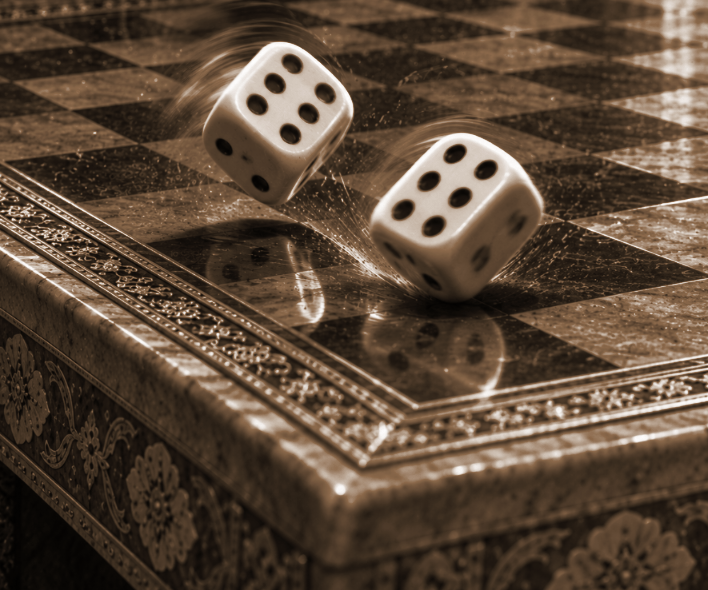
As planned, Shekun lunged and pretended to keep the dice on the board when, in fact, he swapped them with a forged set.
As soon as the two and the four settled on the board, the palace guards moved to shackle each of Queen Draupadi’s husbands.
“Not him,” ordered Duryodh, pointing at Yudhistha. “Not yet.”
“Leave him alone!” Draupadi cried. “Isn’t it enough that you’ve just won his kingdom, his brothers, and his freedom?”
“But that’s just it, your Majesty,” Duryodh replied with mock respect, holding Yudhistha’s stare. “I too have five blood brothers and am heir to an even older, even greater kingdom than yours. If that’s all your husband was willing to wager, then at best his honor would merely equal mine, would it not?
“Although…” he continued, eyes drifting over to Queen Draupadi,
“I suppose there is one thing Yudhistharaja has that I do not.”
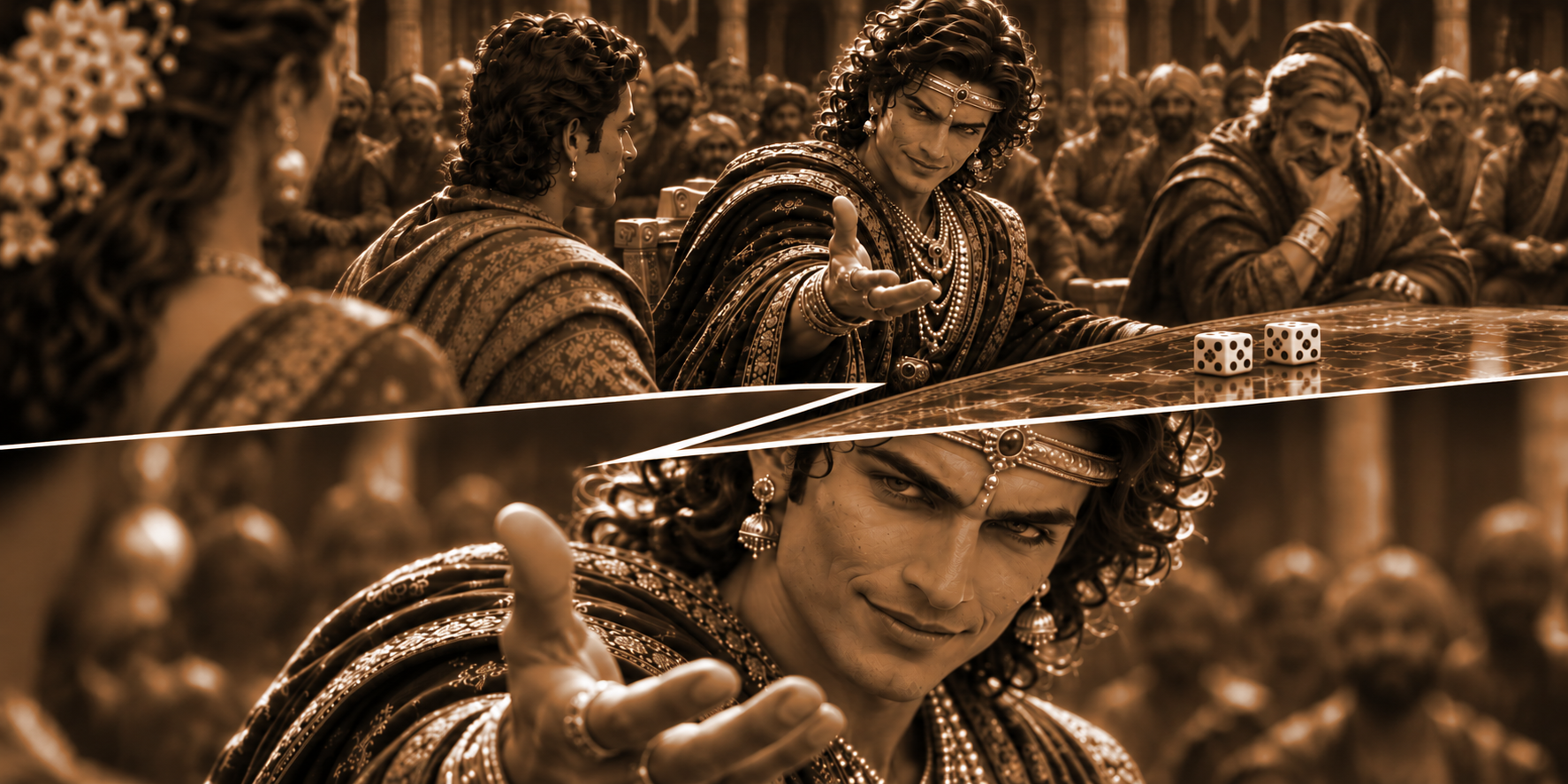
Draupadi whirled on her husband and opened her mouth to speak but he jumped in front of her and returned Duryodh’s glare.
“I swear on the life of my Queen.”
Reaching down, he grabbed the dice, tossed them into the air, and repeated his bet: “Six!”
If Yudhistha had taken but a moment to listen to his wife, she could have warned him. Not to change his bet, of course (to call a different number was as good as admitting the gods were right the first time); but that the game was rigged! She had spotted Shekun’s trickery but it all happened so fast—the swap, the invitation to recast, the immediate acceptance.
And now she stood, surrounded by enemies, all alone in the center of the Hastinapura courtyard.
Helpless.
After all, the law of Dyuta was clear. She had been wagered and lost, so she was no longer a Queen. Draupadi was little more than cattle.
So, drunk with victory, Duryodh grabbed her sari and began to pull.
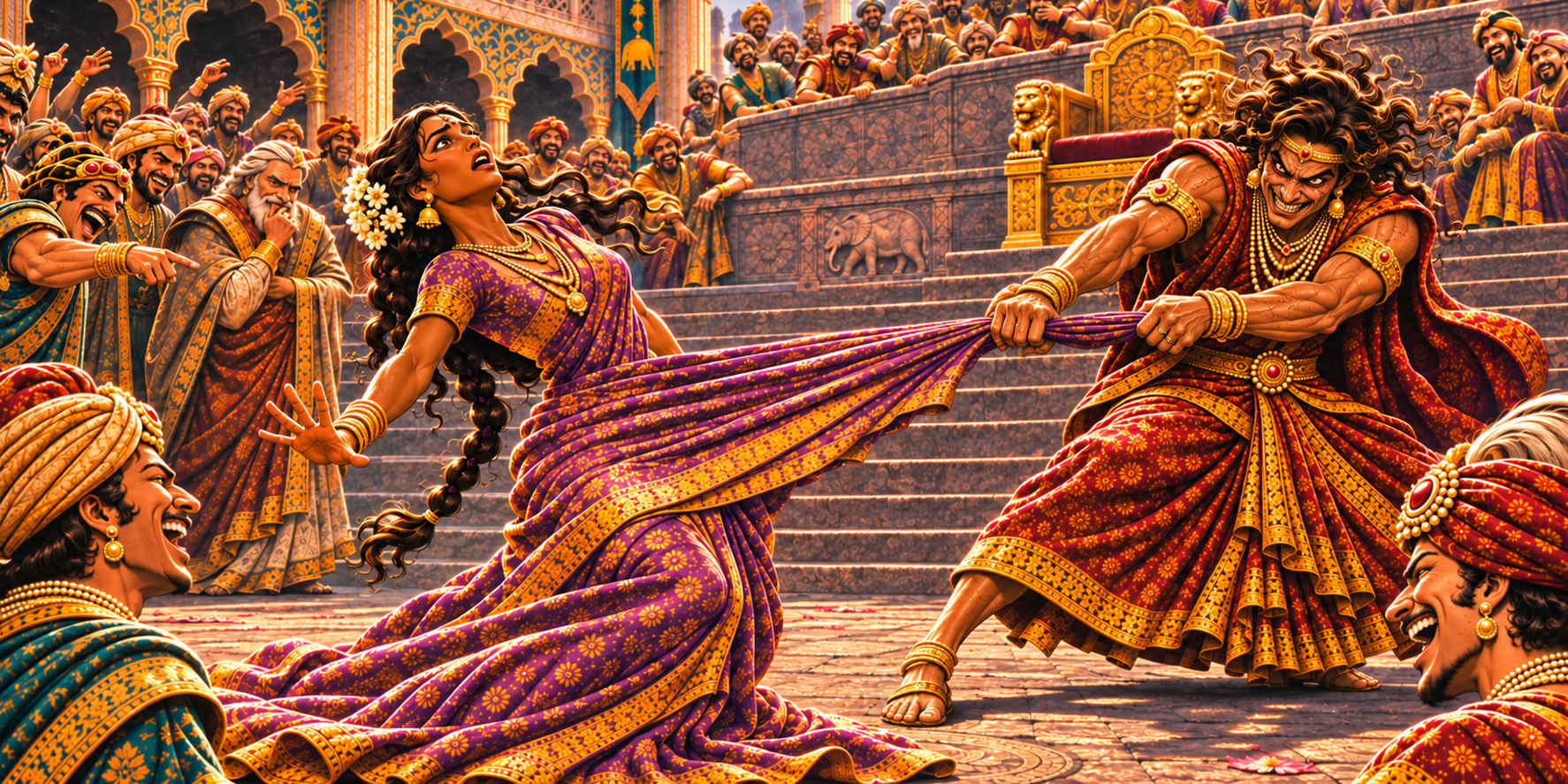
Draupadi stumbled as she spun. She tried to get to her feet and run away but the Kauravasthi courtiers quickly joined in. They harried and distracted her, spinning her in circles till she was too dizzy to think and all she could do was pray.
As a particularly dark swatch of the sari whirled away in front of her eyes, Draupadi remembered a promise and spoke it out loud, hoping beyond hope that it hadn’t been a dream: “Krishna!”
The cousins barked in laughter and started taking turns. Shekun tugged off her earrings. Karna and Dusha yanked at her bungri.
But no matter how hard they pulled, no matter how many lengths they uncoiled, still there was more cloth. Yards turned into fathoms, turned into bolts and reams and bales. Before long, all of Hastinapura was practically buried in the warp and wend of the sari that did not end, until every man in the courtyard was so tired they couldn’t move under the weight of that endless dress.
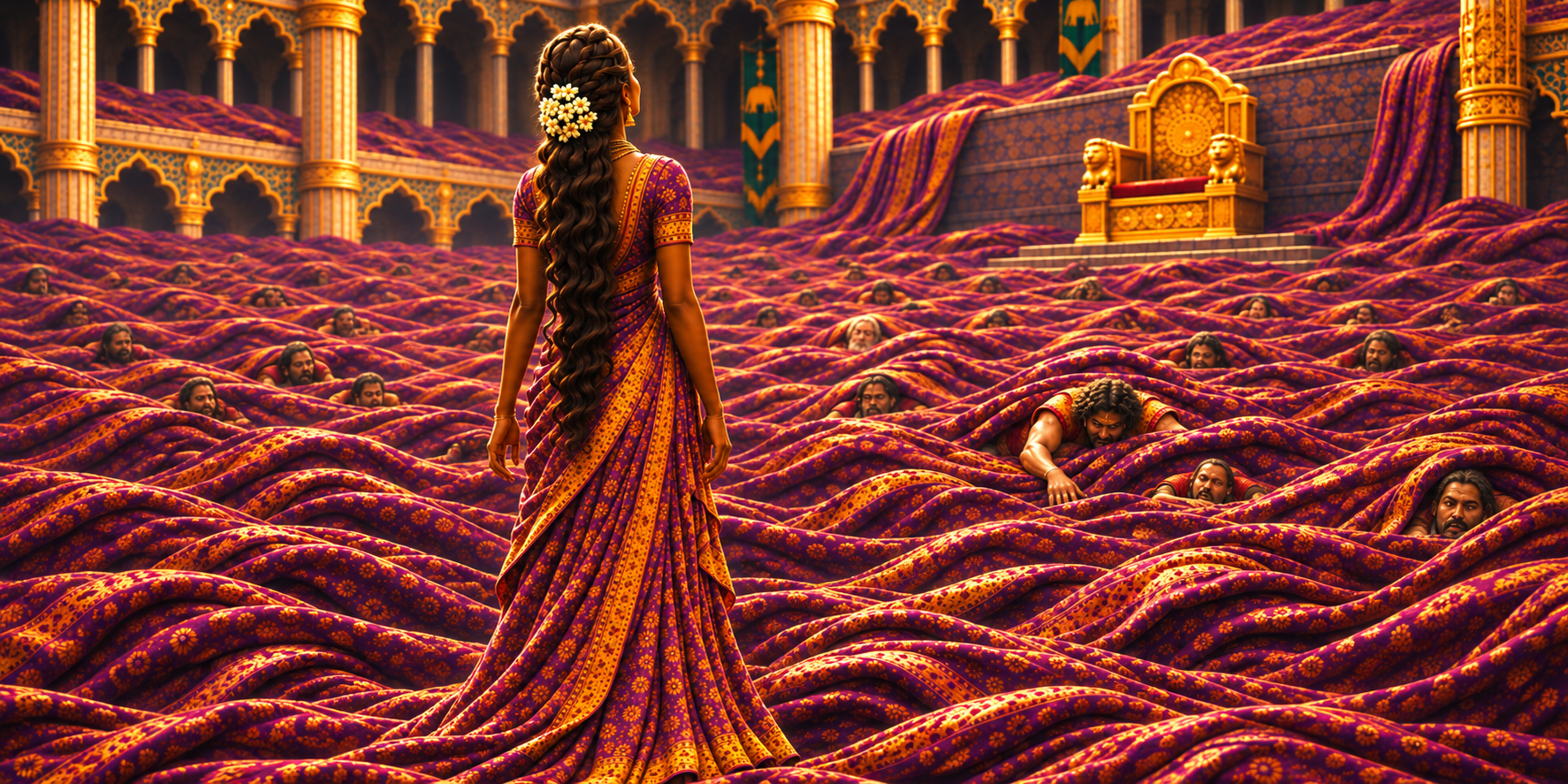
Queen Draupadi stood and took in the scene. Lying there, under all that fabric, the Kauravasthi seemed so very small. Silly, even.
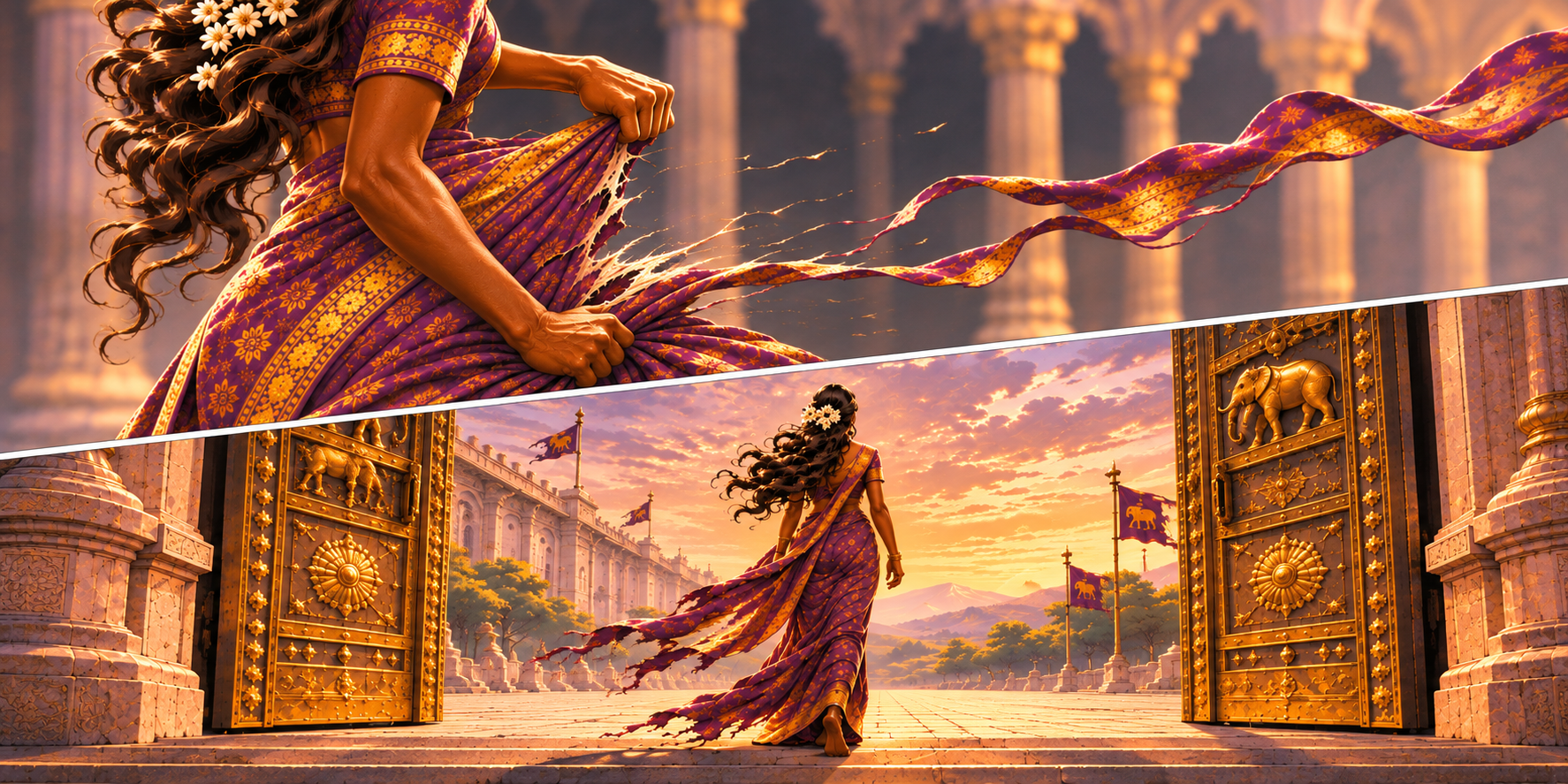
With a calm that suited the Queen of Panchla, Draupadi reached down, ripped her sari, and walked right out the palace gates.